
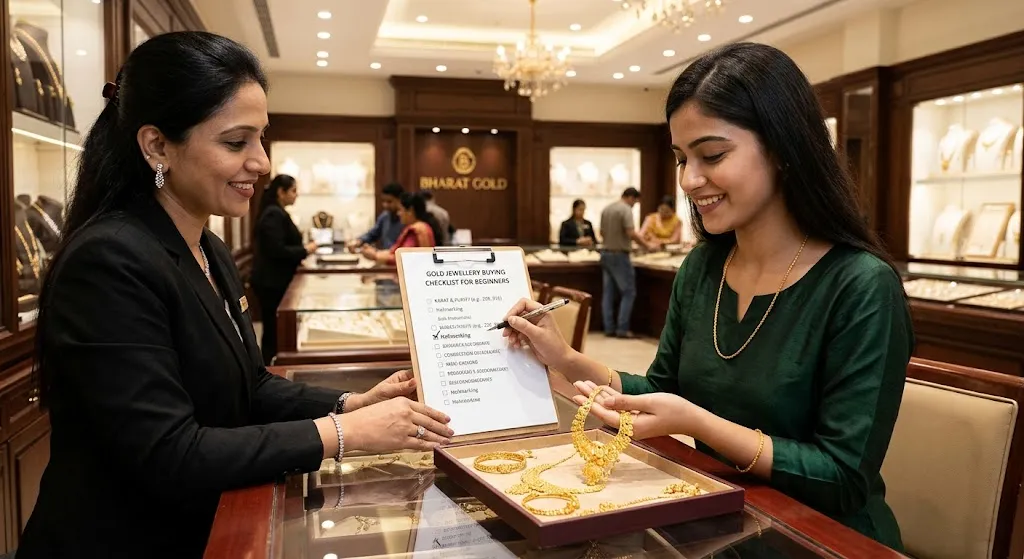
A step-by-step checklist for your first purchase: what to decide before you leave home, what to ask and check at the counter, and what to keep once you have paid.
✍️ Written by Muhammad Usman, Founder & Editor · 🔍 Last reviewed: October 2026 · ⏱ 14-minute read
💡 The Short Answer
Buying gold jewellery safely comes down to three stages and five numbers.
- Before you shop: decide your purpose, set a budget that includes making charges, pick a karat and check today’s live rate.
- At the shop: verify the karat, the weight and the making charge — separately — and inspect the craftsmanship.
- After you buy: keep the itemised receipt, photos and any certificate somewhere safe.
- The five numbers to know every time: karat · net weight · rate used · making charge · total. If a seller cannot give you all five in writing, slow down.
📑 What’s Inside
- How to use this checklist
- Stage 1: Before you shop
- Your budget, worked backwards
- Which karat for which purpose
- Stage 2: At the shop
- Inspecting the finished piece
- The receipt: what must be on it
- Stage 3: After you buy
- Common situations beginners face
- Ten beginner mistakes
- Myths, corrected
- The pocket checklist
- Frequently asked questions
- How we wrote and checked this guide
How to Use This Checklist
Buying gold is stressful for a simple reason: the gold looks the same whether you pay a fair price or an inflated one, and a mistake is expensive. A checklist helps because it takes decisions out of the heat of the moment, when a shop is busy and a salesperson is friendly and quick.
The list is organised in the order you will actually experience a purchase:
| Stage | When | What you are doing |
|---|---|---|
| 1. Before you shop | At home, days before | Deciding what you want, what you can spend and what to expect |
| 2. At the shop | At the counter | Verifying purity, weight and price, and inspecting the piece |
| 3. After you buy | When you get home | Recording, storing and protecting what you bought |
Each stage links to a deeper guide for the parts that deserve one. You do not need to read them all before shopping — just use this page as your map. A condensed version you can copy to your phone is at the end.
Stage 1: Before You Shop
☐ 1. Decide the purpose first. Everything else follows from this. The same budget buys very different things depending on whether you will wear a piece daily, keep it for occasions, or hold it as savings.
| If the purpose is… | Think about… |
|---|---|
| Daily wear (ring, chain, bangle) | Durability and a lower total cost |
| Occasion or bridal wear | Richer colour and craftsmanship |
| Savings or investment | Low premium and easy resale — often bars or coins rather than jewellery |
| A gift | Recipient’s taste, size and the likelihood they will wear it |
☐ 2. Set a budget that covers more than the gold. Your total will include the metal, the making charge, any stones and possibly taxes. The next section shows how to work out how much gold your budget really buys.
☐ 3. Choose a karat. Karat decides purity, colour, durability and price per tola. See the karat table below, or read the full 24K vs 22K vs 21K comparison before deciding.
☐ 4. Check today’s live rate. The rate moves, sometimes more than once a day. Use the live gold calculator to see the metal value for your karat and weight, so you walk in knowing the number.
☐ 5. Learn the three terms you will hear.
| Term | Meaning |
|---|---|
| Karat | How pure the gold is (out of 24 parts) |
| Net weight | The weight of the gold itself, excluding stones |
| Making charge | The labour and workshop cost on top of the metal |
☐ 6. Plan where to shop. Wholesale-oriented markets tend to have lower making charges, general retail sits in the middle, and showrooms are usually at the upper end. Our city guides at the end of this article cover the markets in Karachi, Lahore, Islamabad, Rawalpindi and Faisalabad.
☐ 7. Pick your timing. Peak wedding months raise demand and reduce flexibility. If your date is flexible, a weekday visit outside the peak is usually calmer, with more of the salesperson’s attention.
☐ 8. Bring someone. A second pair of eyes — ideally someone who has bought gold before — helps you stay calm and avoid being rushed.
☐ 9. Plan how you will pay and document it. Decide in advance how you will pay and make sure the receipt will record exactly what you paid for.
Your Budget, Worked Backwards
Most beginners ask “how much gold can I get for my budget?” and get a surprise, because the making charge quietly reduces it. The formula is simple:
Gold you can afford (tola) = Budget ÷ [Rate per tola × (1 + making %)]
If there are stones, subtract their price from the budget first.
Worked example
(Illustrative numbers, to show the method — not today’s rates.) Suppose 21K costs about Rs 87,590 per tola and your budget is Rs 200,000.
| Making charge | Price per tola including making | Gold you can buy |
|---|---|---|
| 7% | ≈ Rs 93,720 | ≈ 2.13 tola (≈ 24.9 g) |
| 10% | ≈ Rs 96,350 | ≈ 2.08 tola (≈ 24.2 g) |
| 18% | ≈ Rs 103,360 | ≈ 1.94 tola (≈ 22.6 g) |
| 10%, plus Rs 20,000 of stones | — | ≈ 1.87 tola (≈ 21.8 g) |
What this shows: on the same budget, the difference between a low and a high making charge is more than 2 grams of gold — and stones take another chunk. Knowing this before you walk in changes how you compare quotes. For the full breakdown of how making charges are quoted, calculated and compared, read our guide to understanding making charges in Pakistan.
Which Karat for Which Purpose
| Karat | Purity | Best for | Trade-off |
|---|---|---|---|
| 24K | 99.9% | Savings: bars and coins | Very soft — not suited to daily wear |
| 22K | 91.6% | Bridal and heirloom pieces | Richer colour, but softer for daily use |
| 21K | 87.5% | Everyday jewellery | Slightly paler, but the most durable of the three |
- If you are buying something for daily wear, start with our 21K gold guide.
- If you are buying bridal or heirloom jewellery, the 22K gold guide explains why it dominates that category.
- If you want pure savings, the 24K gold guide covers bars, coins, certificates and storage.
There is no universally best karat — only the right one for your purpose.
Stage 2: At the Shop
☐ 10. Ask the five key questions before you fall for a design.
- “What is the karat of this piece?”
- “What is the net gold weight?”
- “Which rate are you using today?”
- “What is the making charge, and how is it calculated — percentage, per tola, per gram or per piece?”
- “Is wastage included in that, or separate?”
A confident, established seller will answer all five calmly. Reluctance is information.
☐ 11. Read the stamp yourself. Look for the purity mark — 999, 916, 875 or the karat label — on the clasp or an inconspicuous edge, using a loupe or your phone’s zoom. Ask whether the stamp is an independent hallmark or the shop’s own; our guide to what hallmarking is and why it matters explains the difference and why it matters so much.
☐ 12. Watch it being weighed. Insist that the piece is weighed on a calibrated scale in front of you, before any price discussion.
☐ 13. Do your own metal-value check. Multiply the net weight by today’s live rate for that karat. Whatever the quote is above that number is making charge, stones and taxes. Ask the seller to explain every part of the gap.
☐ 14. Convert the making charge to an effective percentage. (Making charge ÷ metal value) × 100. This lets you compare a “12%” quote with a “Rs 10,000 per tola” quote honestly.
☐ 15. Run a few quick screening checks if you wish. Simple screening — a loupe, a strong magnet and a weight check — can flag obvious problems. Our guide to how to check gold purity at home shows which tests actually work and which are myths. Remember that no home test replaces professional testing on a valuable piece.
☐ 16. Compare at least two shops for a meaningful purchase. Same design, same karat, same approximate weight — then compare effective percentages and totals.
☐ 17. Negotiate the labour, not the honesty. The metal rate follows the public benchmark; the making charge is where there is room to discuss. Never accept a lower making charge in exchange for a missing receipt, a vaguer description or a lower karat.
☐ 18. Ask about buyback and exchange before you pay. What deduction applies? Is it in writing? Making charges are generally not recovered on resale, so this is worth knowing now.
☐ 19. Insist on a fully itemised receipt. Details are in the receipt section below.
Inspecting the Finished Piece
A piece can be genuine gold and still be badly made. Check the craftsmanship with your own eyes and hands:
| Check | What good looks like | Warning sign |
|---|---|---|
| Clasp and safety catch | Closes firmly, feels secure | Loose, stiff or flimsy |
| Joints and solder points | Clean and the same colour as the rest | Rough, visibly different yellow |
| Surface finish | Even polish, no pits or rough patches | Scratches, bubbles or flaking |
| Symmetry | Pairs match; patterns line up | Uneven earrings, crooked settings |
| Stones (if any) | Set tightly, none loose | Rattling or visible gaps around stones |
| Chain links | Move smoothly and evenly | Kinks, stiff or uneven links |
| Edges and inner surfaces | Same colour all over | A different colour showing through, which can mean plating |
| Weight versus size | Feels appropriately solid | Unusually light for its size, which can mean a hollow construction |
Hollow versus solid: hollow pieces look large for their weight and can cost less, but they dent more easily and are harder to repair. That is not a defect if it is disclosed and priced accordingly — it simply should not be a surprise.
☐ 20. Try it on or test the fit. Check the size, comfort and ease of resizing, particularly for rings and bangles. Ask whether resizing is possible and what it costs.
The Receipt: What Must Be On It
The receipt is your proof of what you bought and what you were told. It should not be a single total on a scrap of paper. Check that it records:
| Field | Why it matters |
|---|---|
| Date and shop details | Establishes the transaction |
| Description of the piece | So it can be identified later |
| Karat / purity | Your evidence of what was stated |
| Gross weight and net gold weight | Separates gold from stones |
| Rate used | Lets you verify the metal value |
| Metal value | The gold portion on its own |
| Making charge (and how it was calculated) | The labour portion on its own |
| Wastage (if separate) | So you do not pay twice |
| Stones and their prices | Itemised separately |
| Taxes (if applicable) | Appear as their own line |
| Total paid | The sum of everything above |
☐ 21. Photograph the receipt and the piece’s marks right away, before you leave the shop.
Why this level of detail? If there is ever a disagreement — about purity, weight or price — the itemised receipt settles it. A vague receipt settles nothing.
Stage 3: After You Buy
☐ 22. Store the documents separately from the jewellery. Keep the receipt and any certificate in a different place, with a photo copy stored digitally.
☐ 23. Keep a simple record. A notebook or spreadsheet with the date, karat, weight, price and shop is enough. It makes future decisions — resale, insurance, Zakat — far easier.
☐ 24. Store the piece safely. Keep pieces separate, in soft pouches, to prevent scratching. For significant holdings, think about a safe or a bank locker and whether your insurance actually covers jewellery.
☐ 25. Plan for Zakat. Gold you own may be subject to Zakat once your total qualifying gold reaches the Nisab threshold and has been held for a lunar year. Zakat is calculated on the value of the gold, not the labour charge. Our Gold Zakat Calculator uses the live rate and includes a Nisab check. Rulings can vary between schools of thought, so consult a qualified scholar for your own situation.
☐ 26. Care for the piece. Gentle cleaning with a soft cloth and mild soap, and removing jewellery before heavy manual work or swimming, extends its life.
☐ 27. Re-test before you sell. If you ever sell, get the purity confirmed professionally so you know what you are negotiating about.
Common Situations Beginners Face
| Situation | What to do |
|---|---|
| “I trust this jeweller — my family has used him for years.” | Still get the itemised receipt and the stamp check. Trust and verification work together |
| Buying online | Choose a seller with a clear track record, get karat and weight in writing, understand the return policy, and check the weight on delivery |
| Exchanging old gold for new | Verify the purity of the old gold, ask what deductions apply, and keep the exchange in writing |
| Buying a gift for someone else | Ask about exchange or resize policies, and keep the receipt with the gift |
| Buying in a different city or country | Rates and practices differ; check current rules on bringing gold across borders with the relevant authority |
| Inherited or unmarked jewellery | Do not assume anything either way — get it tested professionally |
| A very low price | Treat it as a question to investigate, not a bargain to grab |
Ten Beginner Mistakes
- Shopping without checking the live rate first.
- Comparing totals instead of the five numbers.
- Not asking how the making charge is calculated.
- Paying for wastage twice.
- Skipping the weighing.
- Accepting a verbal promise instead of a written line on the receipt.
- Buying jewellery as an “investment” when bars or coins would suit that goal better.
- Choosing 22K for daily wear without realising it is softer than 21K.
- Not thinking about resale until it is time to sell.
- Feeling rushed and agreeing to things you did not understand.
The fix for almost all of these is the same: slow down, ask for the breakdown in writing, and compare.
Myths, Corrected
❌ “A higher karat is always the better buy.”
✅ It is better for savings. For daily wear, its softness works against it.
❌ “The lowest price is the best deal.”
✅ Only if the karat, weight and receipt are identical. Otherwise it may simply be a lower purity or a lower real weight.
❌ “Making charges are fixed by law.”
✅ As far as we know, there is no single price list every jeweller follows. They are set by the shop and often negotiable.
❌ “A stamp means the gold is hallmarked.”
✅ A stamp may be the jeweller’s own mark. A hallmark implies independent testing.
❌ “If the jeweller is famous, I don’t need a receipt.”
✅ The receipt is your protection, whoever the seller is.
The Pocket Checklist
Copy this into your phone before you go:
Before
☐ Purpose decided ·
☐ Budget includes making and stones ·
☐ Karat chosen ·
☐ Live rate checked ·
☐ Market chosen ·
☐ Timing planned
At the counter
☐ Karat stated ·
☐ Stamp read ·
☐ Net weight confirmed on scale ·
☐ Rate confirmed ·
☐ Making charge and method asked ·
☐ Wastage clarified ·
☐ Effective % calculated ·
☐ Craftsmanship inspected ·
☐ At least two quotes compared ·
☐ Buyback policy asked ·
☐ Itemised receipt received ·
☐ Receipt and marks photographed
After
☐ Documents stored separately ·
☐ Purchase recorded ·
☐ Piece stored safely ·
☐ Zakat considered
Frequently Asked Questions
What should a beginner check first when buying gold jewellery?
Check the karat, the net weight and the making charge — separately — and confirm them on an itemised receipt. Compare the metal value against today’s live rate before you agree to a price.
How much more than the gold rate should I expect to pay?
Jewellery costs the metal value plus a making charge, stones and any taxes. Typical making charges run from roughly 7% for plain pieces to 25% or more for intricate bridal work, so the total depends heavily on the design.
Which karat is best for a beginner?
It depends on the purpose. 21K suits daily wear, 22K suits bridal and occasion pieces, and 24K bars or coins suit savings. Decide the purpose first and the karat follows.
Is gold jewellery a good investment?
Jewellery includes labour costs that are generally not recovered on resale, so bars or coins usually suit pure investment better. Jewellery makes more sense when you want to wear and keep it. This is general information, not financial advice.
How do I know the gold is genuine?
Read the purity stamp, ask whether it is an independent hallmark, watch the piece being weighed and get it in writing. For larger purchases, arrange independent professional testing.
Can I return or exchange jewellery after buying?
Policies vary by shop. Ask before you pay, and make sure the policy, any deductions and the conditions are written on the receipt.
Should I buy gold online as a beginner?
It can be fine with a reputable seller who gives karat and weight in writing and has a clear return policy. Verify the weight and marks on delivery, and be extra careful with unusually low prices.
Do I have to pay Zakat on gold jewellery?
Under the widely followed view, Zakat applies once your total qualifying gold reaches Nisab and has been held for a lunar year, and it is calculated on the gold’s value, not the making charge. Rulings can vary, so consult a qualified scholar.
What documents should I keep?
Keep the itemised receipt, any certificate, photographs of the piece and its marks, and a simple record of the purchase. Store copies separately from the jewellery.
How We Wrote and Checked This Guide
Because this topic involves your money, here is how this article was put together:
- The checklist reflects widely used buying practice and the specific issues covered in our earlier guides on karats, hallmarking, purity testing and making charges.
- Typical ranges (such as making charges) are figures commonly reported by Pakistani jewellers and are presented as a guide, not a guarantee.
- Regulation, taxes and policies can change and differ by shop, so confirm current details with your jeweller or the relevant authority.
- Worked examples are clearly labelled illustrative and are not quoted prices.
- No shops, brands or products are recommended, and nothing in this article is sponsored.
- Live rates are verified against the Sarafa benchmark and international spot pricing, as explained on our About Us page.
- Corrections: if you spot something wrong or out of date, please contact us — every report is reviewed.
Not financial or legal advice. This is general educational information. Confirm current rates, making charges, taxes and policies directly with your dealer before a transaction, and consult a qualified scholar for personal Zakat rulings. See our full Disclaimer.
🔗 Explore the City Guides
Trusted markets, typical charges and buying tips differ from city to city. Read the guide for yours: Karachi · Lahore · Islamabad · Rawalpindi · Faisalabad
Written by Muhammad Usman, Founder & Editor of GoldRateInPakistan.org.pk. Last reviewed October 2026. Rates and ranges change — always verify with your dealer before a transaction.