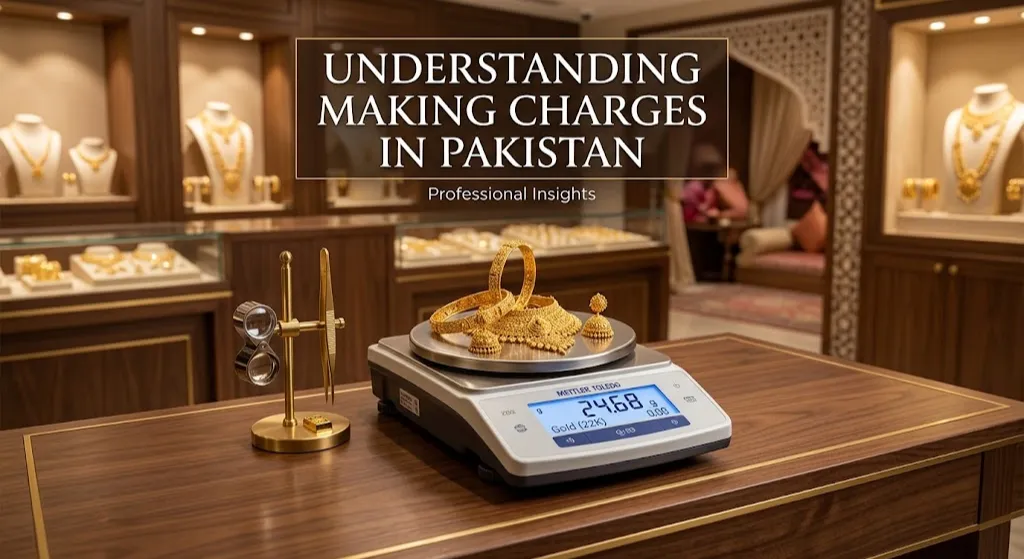
What you are really paying for on top of the gold, how shops quote it, what is normal, how to compare two quotes fairly — and how to stop paying for the same thing twice.
✍️ Written by Muhammad Usman, Founder & Editor · 🔍 Last reviewed: October 2026 · ⏱ 14-minute read
💡 The Short Answer
- Making charges are the labour and workshop cost of turning raw gold into a finished piece. They are completely separate from the gold rate, and they are not part of the metal’s value.
- Total price = metal value + making charge (+ stones + any taxes). The metal value follows the public benchmark; the making charge is where shops differ.
- Shops quote it in different ways — a percentage, a flat rate per tola or gram, or a fixed price per piece. You cannot compare them until you convert each to the same measure.
- Typical ranges run from single digits for plain pieces to 25% or more for intricate bridal work, and they are generally not recovered when you resell.
- The best protection is simple: get the making charge quoted separately, in writing, and compare it as an effective percentage.
📑 What’s Inside
- What making charges actually are
- The price formula, broken down
- How shops quote making charges
- The effective-percentage trick
- What drives making charges up or down
- Typical ranges in Pakistan
- Wastage: how to avoid paying twice
- Stones, polish and other extras
- What you lose when you resell
- How to compare two quotes fairly
- Negotiating sensibly
- Making charges across karats, bars and silver
- Red flags and common mistakes
- Myths, corrected
- A pre-purchase checklist
- Frequently asked questions
- How we wrote and checked this guide
What Making Charges Actually Are
When you buy a gold bangle, you are paying for two different things:
- The gold itself — a known weight of a known purity, priced from the public market rate.
- The work — everything it took to turn that gold into a finished, wearable object.
The second part is the making charge. It usually covers:
- Labour of the goldsmith, designer, setter and polisher
- Machinery and tooling (casting, cutting, finishing equipment)
- Workshop overhead and a share of the shop’s costs
- The jeweller’s profit on the craftsmanship
What it does not include: the metal’s value, the value of any gemstones, and any taxes — each of these should be a separate line.
Why this matters: the gold rate is public and moves every day. The making charge is set by the shop and is negotiable. It is the part of the price where two honest jewellers can legitimately differ — and where most overpayment happens.
The Price Formula, Broken Down
Every jewellery price in Pakistan can be written as:
Total price = Metal value + Making charge + Stones + Taxes (if applicable)
| Component | How it is worked out | Can it vary between shops? |
|---|---|---|
| Metal value | Weight × the day’s rate for that karat | Barely — it follows the public benchmark |
| Making charge | Percentage, flat rate or per-piece price | Yes, a lot |
| Stones | Priced separately by type, size and quality | Yes |
| Taxes | According to the rules and the shop’s registration | Depends on rules at the time |
You can check the metal value yourself in seconds with the live homepage calculator: enter the karat, weight and unit, and you have the metal portion. Whatever the quote is above that figure is making charge, stones and taxes — which means you can ask the shop to explain every rupee of the difference.
How Shops Quote Making Charges
This is the single biggest source of confusion. Four formats are common:
| Format | Example | What to watch |
|---|---|---|
| Percentage of metal value | “12% making” | Rises and falls with the gold price |
| Flat rate per tola | “Rs 10,000 per tola” | Stays fixed in rupees whatever the gold price does |
| Flat rate per gram | “Rs 900 per gram” | Same idea, different unit — check which unit is meant |
| Fixed price per piece | “Rs 35,000 making for this set” | Easy to understand, but hides weight and percentage |
| “All-in” price | One total, no breakdown | Impossible to compare — ask for the split |
Units you will hear
Jewellers in Pakistan mix traditional and metric units, so confirm which one is being used:
| Unit | Equals |
|---|---|
| 1 tola | 11.664 grams |
| 1 masha | 1/12 tola ≈ 0.972 grams |
| 1 ratti | 1/8 masha ≈ 0.1215 grams |
A quote “per masha” or “per tola” can look small or large depending on the unit, so always ask: “Per what — tola, masha or gram?”
The Effective-Percentage Trick
The way out of the confusion is to turn every quote into the same measure:
Effective making % = (making charge ÷ metal value) × 100
Once every shop’s quote is expressed this way, you can compare them honestly.
Worked example: percentage versus flat rate
(These numbers are illustrative, to show the method — not today’s rates.) Assume 22K costs about Rs 91,750 per tola and you want a 3-tola set.
| Shop A | Shop B | |
|---|---|---|
| How they quote | 12% of metal value | Flat Rs 10,000 per tola |
| Metal value (3 × Rs 91,750) | Rs 275,250 | Rs 275,250 |
| Making charge | Rs 33,030 | Rs 30,000 |
| Total | Rs 308,280 | Rs 305,250 |
| Effective % | 12.0% | 10.9% |
Shop B’s “Rs 10,000 per tola” sounds like more than a modest percentage, yet it works out cheaper here. You would never know without converting.
How the gold price changes the picture
Percentage quotes move with the gold price. Flat quotes do not. Watch what happens if the gold rate were 50% higher:
| Gold price scenario | Shop A (12%) | Shop B (Rs 10,000 per tola) |
|---|---|---|
| Rate as above | Rs 33,030 | Rs 30,000 |
| Rate 50% higher | Rs 49,545 | Rs 30,000 (effective 7.3%) |
Takeaway: when gold is expensive, a flat per-tola charge tends to work out better; when gold is cheap, a percentage can be the better deal. The point is not to memorise a rule — it is to always check the effective percentage on the day you buy.
What Drives Making Charges Up or Down
| Driver | Effect on the charge | What you can do |
|---|---|---|
| Design complexity | Intricate filigree, kundan and fine hand-finishing cost more | Ask whether a simpler pattern would look similar |
| Technique | Hand-finished work generally costs more than machine-made | Compare machine-made and hand-finished versions |
| Piece weight | Light, delicate pieces carry a higher percentage, because skilled work does not shrink in proportion to weight | Expect higher % on small items |
| Stones and settings | Setting adds labour on top of the stones’ own price | Ask for stones and setting itemised |
| Karat | 22K bridal designs typically carry higher charges than everyday 21K | See the karat section below |
| Shop type | Branded showrooms add overhead; wholesale-oriented markets are usually leaner | Compare more than one type of shop |
| Season | Peak wedding months raise demand and reduce flexibility | Buy off-peak if you can |
| Shop policy | Some shops negotiate, others fix prices | Ask early, politely |
Why lighter pieces cost more per gram
(Illustrative.) Suppose the labour for a delicate pair of earrings and for a plain bangle is the same Rs 4,000:
| Piece | Weight | Metal value | Rs 4,000 labour as a % |
|---|---|---|---|
| Delicate earrings | 5 g | ≈ Rs 39,300 | ≈ 10.2% |
| Plain bangle | 20 g | ≈ Rs 157,300 | ≈ 2.5% |
That is why small, intricate items often feel “expensive for their size” — you are paying mostly for skill, not metal.
Typical Ranges in Pakistan
There is no single official price list that every jeweller follows, as far as we know. Making charges are set by each shop and can be negotiated. The ranges below are typical figures reported by Pakistani jewellers and are a guide, not a rulebook.
By design
| Design type | Typical range |
|---|---|
| Plain, machine-finished (chains, plain bangles, simple rings) | roughly 7% – 13% |
| Moderate detail, semi-formal pieces | roughly 12% – 18% |
| Intricate, hand-finished bridal sets | roughly 15% – 25% or more |
| Branded or designer showroom pieces | can exceed 25% |
By type of market
| Market type | Where charges tend to sit |
|---|---|
| Wholesale-oriented bazaars (dense competition, high volume) | Toward the lower end |
| General retail markets | Middle |
| Showrooms and malls (higher overhead, exclusive designs) | Toward the upper end |
Local detail differs from city to city — which markets are leanest, and what to expect in each. Our city guides at the end of this article cover it for Karachi, Lahore, Islamabad, Rawalpindi and Faisalabad.
Wastage: How to Avoid Paying Twice
In some shops you will hear a second term alongside making charges: “wastage” (sometimes called waste or kat). It refers to an allowance for the small amount of gold lost during crafting, such as filings and polishing dust.
Practices differ from shop to shop, so the safe approach is to ask directly:
- “Is wastage included in your making charge, or is it separate?”
- “Is it a percentage, or a weight deduction?”
- “Please show both on the receipt.”
The mistake to avoid: paying a “making charge” that already includes wastage, and then being charged wastage again as a separate line. Two shops quoting the same total can be structured very differently, so always ask for the split before you compare.
Stones, Polish and Other Extras
Several things may appear on a quote besides the metal and making charge:
| Extra | What to ask |
|---|---|
| Gemstones and diamonds | Type, size, quality grade and the price per stone, separate from the gold |
| Stone-setting | Whether it is included in the making charge or charged on top |
| Polishing or plating (such as rhodium) | Whether it is optional and what it costs |
| Boxes and packaging | Whether they are priced into the total |
| Taxes | Which taxes apply and where they appear on the receipt |
Tip: the stone weight is usually included in the piece’s gross weight but is not gold. Make sure the net gold weight is what the metal value is calculated on.
What You Lose When You Resell
This is the part most buyers never consider until it is too late. When you sell or exchange jewellery, a buyer generally pays for metal weight and purity. The making charge, being a labour cost, is typically not returned.
Worked example
(Illustrative.) You buy the 3-tola set from Shop A for Rs 308,280 (metal Rs 275,250 + making Rs 33,030). Suppose the gold rate has not moved when you sell, and the buyer pays for the metal only:
| You paid | Rs 308,280 |
| You receive (metal only, same rate) | ≈ Rs 275,250 |
| Making charge you do not get back | ≈ Rs 33,030 (about 10.7% of what you paid) |
Many shops also apply some deduction on buyback, and policies vary — so ask in advance what a buyback or exchange would look like, ideally in writing.
What this means in practice:
- Gold you buy purely for savings is usually better held as bars or coins, where the premium is small (see the karat section).
- Heavily crafted pieces make sense when you want to wear and keep them, not as an investment.
- Whenever you sell, verify purity first. Our guides on what hallmarking is and why it matters and how to check gold purity at home explain how to do that before a buyer tells you what your piece is worth.
How to Compare Two Quotes Fairly
Use the same five steps every time:
- Fix the piece. Compare the same design, karat and approximate weight.
- Get the numbers in writing: karat, gross weight, net gold weight, the rate used, the making charge, and stones separately.
- Check the rate. Confirm the rate is today’s rate for that karat, not an old or rounded one.
- Convert to an effective percentage with the formula above.
- Compare the total — but only after steps 1 to 4.
A quote comparison template
Copy this into your notes:
| Shop 1 | Shop 2 | Shop 3 | |
|---|---|---|---|
| Karat | |||
| Net gold weight | |||
| Rate used | |||
| Metal value | |||
| Making charge (Rs) | |||
| Effective % | |||
| Stones / extras | |||
| Total |
Filling this in takes five minutes and usually shows exactly where the differences are.
Negotiating Sensibly
Making charges are often negotiable, particularly in wholesale-oriented markets, on larger purchases and outside peak seasons. A few approaches that work without being confrontational:
- Compare, then say so. “Another shop quoted 10% for a similar design — can you match it?” is fair and factual.
- Ask for the split first. A shop that gives a clear breakdown is easier to negotiate with than one quoting a single total.
- Consider a flat rate when gold is high, as the worked example showed.
- Buy in a wholesale-oriented market for larger purchases, where competition between dealers narrows the gap.
- Buy off-peak where timing is flexible.
- Do not negotiate the metal rate. It follows the public benchmark; the part worth discussing is the making charge.
Negotiate the labour, never the honesty. Do not accept a lower making charge in exchange for a lower karat or weight, a missing receipt or a vague “no problem.” A discount that depends on cutting corners is not a discount.
Making Charges Across Karats, Bars and Silver
24K bars and coins
Investment gold typically carries a premium over the metal price rather than a design-based making charge, and it is generally much smaller than jewellery’s. See our 24K gold guide for bars versus coins, certification and storage.
22K jewellery
Bridal and fine designs are intricate by nature, so charges tend to be at the higher end. The 22K gold guide covers care, hallmarks and what to expect.
21K jewellery
Everyday designs are simpler and produced in higher volumes, so charges are generally lower. The 21K gold guide explains why this karat dominates Pakistani retail.
| Karat | Typical making charge | Why |
|---|---|---|
| 24K bars / coins | Small premium only | Almost no design labour |
| 22K | roughly 10% – 25%+ | Intricate bridal and fine work |
| 21K | roughly 7% – 20% | Simpler, everyday designs |
If you are still deciding which karat suits your purpose, our 24K vs 22K vs 21K comparison walks through the trade-offs, including a worked cost example.
Silver
Silver’s base price per gram is low, so labour makes up a larger share of the total and charges are often higher in percentage terms. Our silver rate guide covers this.
Red Flags and Common Mistakes
- A single “all-in” price with no split between metal and making
- A making charge calculated on the wrong base — such as on gross weight including stones, instead of net gold weight
- Comparing totals before converting to a common measure
- Wastage charged twice — once inside the making charge and again as a separate line
- A verbal quote with nothing in writing
- A price far below the metal value for the claimed karat and weight — the difference has to come from somewhere
- Pressure to decide quickly, or reluctance to put the breakdown on paper
- Forgetting that making charges are not recovered when you plan to resell
Myths, Corrected
❌ “Making charges are set by law, so every shop charges the same.”
✅ As far as we know, there is no single price list every jeweller follows. Charges are set by each shop and often differ widely.
❌ “A low making percentage means a cheap piece.”
✅ Not necessarily — a low percentage on a heavy piece can be more rupees than a higher percentage on a light one. Compare totals after converting.
❌ “The shop with the lowest making charge is always best.”
✅ Only if the karat, weight and receipt are genuinely the same. A low charge paired with a lower real purity is not a bargain.
❌ “Making charges are part of the gold’s value.”
✅ They are labour cost. They are generally not recovered on resale and are not counted as gold value for Zakat.
❌ “Bargaining on the gold rate saves money.”
✅ The metal rate follows the public benchmark. The place to negotiate is the making charge.
A Pre-Purchase Checklist
- Decide the purpose — daily wear, occasional wear or savings.
- Check today’s live rate for the karat before you go.
- Visit more than one type of shop if the purchase is meaningful.
- Ask for karat, net weight, rate, making charge and stones separately.
- Ask whether wastage is included in the making charge.
- Convert each quote to an effective percentage.
- Confirm purity — read the stamp, and get a professional test for larger purchases.
- Ask what a buyback or exchange would look like, in writing.
- Get a full itemised receipt and keep it safe, with a photo copy.
Frequently Asked Questions
What are making charges in simple words?
Making charges are the labour and workshop cost of turning raw gold into jewellery. They are charged on top of the gold’s value and are separate from the gold rate.
How are making charges calculated in Pakistan?
Shops use a percentage of the metal value, a flat rate per tola or gram, or a fixed price per piece. To compare them, convert each to an effective percentage: making charge divided by metal value, times 100.
What are normal making charges for gold jewellery?
Typically roughly 7% to 13% for plain machine-finished pieces and 15% to 25% or more for intricate hand-finished bridal work. Showrooms can charge more. These are guide figures, not fixed rules.
Are making charges negotiable?
Often yes, especially in wholesale-oriented markets, on larger purchases and outside peak wedding season. Showroom prices tend to be more fixed. Compare quotes and ask for the breakdown first.
Do I get making charges back when I sell gold?
Generally no. Buyers usually pay for metal weight and purity, so the making charge is typically lost on resale. Ask the shop about its buyback policy in writing.
Is a flat making charge better than a percentage?
It depends on the gold price on the day. When gold is expensive a flat rate tends to be better; when it is cheaper a percentage can win. Always compare effective percentages.
What is wastage and is it separate from making charges?
Wastage is an allowance for gold lost during crafting. Some shops include it in the making charge and others list it separately, so ask which applies and avoid paying for it twice.
Are making charges included in Zakat calculations?
No. Zakat is calculated on the value of the gold itself, not the labour paid to shape it. Our Gold Zakat Calculator uses the live metal rate, which is the correct basis.
Why do lighter pieces have higher making charges per gram?
Skilled labour does not shrink in proportion to weight. A delicate 5-gram piece may need nearly as much work as a plain 20-gram one, so the labour is a larger share of its smaller metal value.
How We Wrote and Checked This Guide
Because this topic involves your money, here is how this article was put together:
- Making-charge ranges are typical figures reported by Pakistani jewellers. They are presented as a guide, not a guarantee, and they vary by city, shop, design and season.
- Regulation: we are not aware of a single official price list for making charges. Rules, taxes and practices can change, so confirm current details with your jeweller or the relevant authority.
- Unit conversions use the standard tola (11.664 grams), with the traditional masha and ratti derived from it.
- Worked examples are clearly labelled illustrative and are not quoted prices.
- No shops or brands are recommended, and nothing in this article is sponsored.
- Live rates are verified against the Sarafa benchmark and international spot pricing, as explained on our About Us page.
- Corrections: if you spot something wrong or out of date, please contact us — every report is reviewed.
Not financial or legal advice. This is general educational information. Confirm current rates, making charges and any applicable taxes directly with your dealer before a transaction, and consult a qualified scholar for personal Zakat rulings. See our full Disclaimer.
🔗 Explore the City Guides
Making charges, trusted markets and buying tips differ from city to city. Read the guide for yours: Karachi · Lahore · Islamabad · Rawalpindi · Faisalabad
Written by Muhammad Usman, Founder & Editor of GoldRateInPakistan.org.pk. Last reviewed October 2026. Rates and ranges change — always verify with your dealer before a transaction.