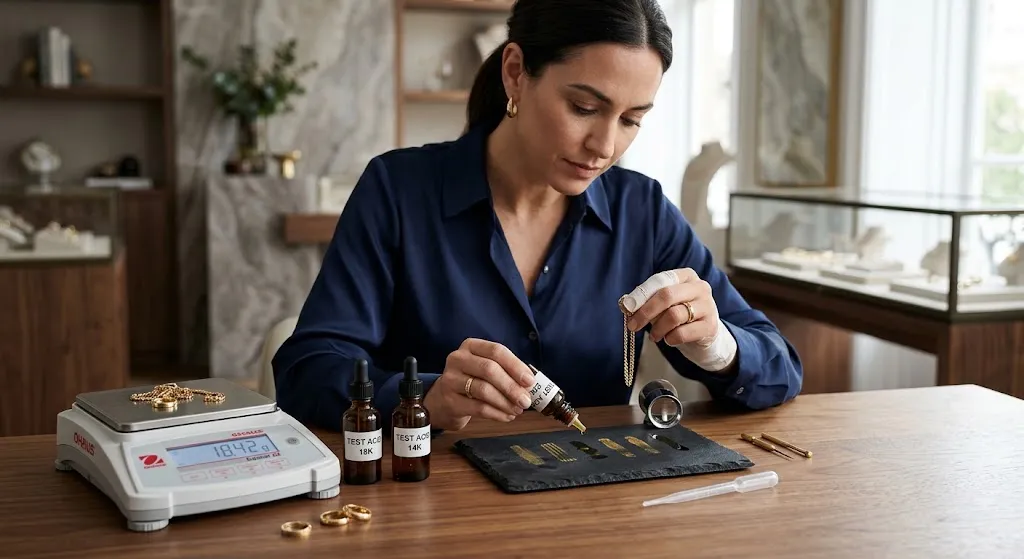
Which simple tests genuinely help, which ones are myths, how to run the water density test step by step — and the point where you should stop experimenting and call a professional.
✍️ Written by Muhammad Usman, Founder & Editor · 🔍 Last reviewed: October 2026 · ⏱ 14-minute read
💡 The Short Answer
- No home test can tell you the exact karat. What home tests can do is catch obvious fakes and tell you whether a professional test is worth paying for.
- The checks that are actually useful: read the stamp, inspect the piece, use a strong magnet, weigh it, run the water density test, and compare the price to today’s live rate.
- Skip acid kits, flames, biting, vinegar and skin tests. They are unreliable, and some are dangerous or damage the piece.
- For anything valuable — a bridal set, a bar, inherited jewellery, a piece you are about to sell — get an independent professional test. No home result replaces it.
📑 What’s Inside
- What “at home” can and cannot do
- What you need before you start
- Test 1: Read the marks
- Test 2: Inspect the piece closely
- Test 3: The magnet test
- Test 4: The water density test, step by step
- Test 5: The price sanity check
- Tests that do not work, or are risky
- All the tests compared
- What your results mean
- When to stop and call a professional
- Checking different types of gold
- Myths, corrected
- A home-screening checklist
- Frequently asked questions
- How we wrote and checked this guide
What “At Home” Can and Cannot Do
Gold purity cannot be seen. Two bangles with the same colour, weight and shine can differ by several percentage points of gold, and nothing in your hands reveals it. That is why testing exists at three different levels, and why it helps to know which level you are at:
| Level | Where | Examples | What it can tell you |
|---|---|---|---|
| 1. Home screening | Your kitchen table | Marks, inspection, magnet, density, price check | Whether a piece is suspicious — not its exact karat |
| 2. Professional testing | An established jeweller or testing counter | Electronic testers, touchstone and acid by a trained person, XRF scanner | A good estimate of purity, usually without damaging the piece |
| 3. Laboratory assay | A testing laboratory | Fire assay (cupellation) | The most accurate result, used for bullion and disputes |
The honest framing: home tests are a smoke detector, not a fire investigation. They tell you when something looks wrong. They do not give you a certificate.
Used together, the simple checks below are surprisingly effective at flagging bad pieces. Used alone, none of them proves anything. Keep that in mind throughout.
What You Need Before You Start
You do not need to buy anything expensive:
- 🔍 A 10x loupe (or your phone camera zoomed in with good light) to read tiny stamps
- 🧲 A strong magnet — a small neodymium magnet works far better than a fridge magnet
- ⚖️ A digital scale with 0.01 g resolution — jewellery scales are inexpensive and essential for the density test
- 🧵 Thin thread, a glass of clean water and a tissue
- 📝 A notebook or phone to record every reading
Ground rules
- Do not damage the piece. If a test would scratch, burn or dissolve it, skip it.
- Never use strong chemicals, flames or heat. You do not need them, and they are hazardous.
- Test more than once and write numbers down. One reading can be a mistake.
- Test your own pieces, or pieces you have the owner’s permission to test.
- Decide in advance what result will make you stop and take the piece to a professional.
Test 1: Read the Marks
What it checks: whether the piece carries a purity stamp, and whether it matches what you were told.
How to do it:
- Look for the stamp on the clasp, the inside of a ring band, or an inconspicuous edge.
- Use the loupe in good light. Note every mark you see.
- Compare what you read with the table below.
| Karat | Purity | What the stamp should say |
|---|---|---|
| 24K | 99.9% | 999 (or 24K) |
| 22K | 91.6% | 916 (or 22K) |
| 21K | 87.5% | 875 (or 21K) |
| 18K | 75.0% | 750 (or 18K) |
| Gold plated | thin gold layer only | GP, GF or RGP — not solid gold |
What the result means:
- ✅ A crisp, evenly struck mark that matches the seller’s claim is a good sign — but only a sign.
- ⚠️ A blurry, uneven or oddly deep mark deserves questions.
- ❌ A GP / GF / RGP mark means the piece is not solid gold, whatever the price tag implies.
- ❓ No mark at all on a high-value piece is a reason to test further, not proof of a fake — many older pieces predate modern marking.
Important: a stamp can be struck by anyone. A jeweller’s own stamp and an independent assay hallmark are very different things. Our guide to what hallmarking is and why it matters explains how to tell them apart.
Test 2: Inspect the Piece Closely
What it checks: physical clues that a piece is plated, filled or assembled from different metals.
How to do it: examine the piece under bright light with the loupe, looking at the places where wear shows first.
| Look at… | A warning sign |
|---|---|
| Edges and corners | A different colour (silvery, reddish or grey) showing through |
| Inside of rings and bangles | Flaking, bubbling or patchy colour |
| Clasps, pins and springs | A noticeably different metal colour from the body |
| Solder joints | A joint that is clearly a different yellow from the rest |
| Surface finish | Unnaturally uniform colour with worn spots on high-contact areas |
What the result means: gold alloys wear down evenly. When a thin layer wears off and a different colour appears underneath, the piece is plated. It is not a perfect test — thick plating can hide for years — but it catches many cheap fakes quickly.
Test 3: The Magnet Test
What it checks: whether the piece contains magnetic metals such as iron, steel or nickel-rich alloys.
How to do it:
- Hold a strong magnet close to the piece, then touch it.
- Watch whether the piece is pulled toward the magnet or sticks to it.
- Test the main body of the piece, not only the clasp.
What the result means:
| Result | Meaning |
|---|---|
| Strongly attracted | Not solid gold — it contains a magnetic metal |
| Slight pull on a clasp or spring only | Often a steel spring inside a genuine clasp — check the main body |
| No reaction | Proves nothing. Gold is non-magnetic, but so are brass, copper, silver, aluminium and tungsten |
Remember the logic: the magnet test can only fail a piece. It can never pass one. A piece that does not react has simply not failed this test.
Test 4: The Water Density Test, Step by Step
This is the most powerful home test, and the one most guides explain badly. It works because every metal has a characteristic density — how much mass fits into a given volume — and gold is unusually heavy.
The idea in one line
Measure how much water the piece displaces, and compare its density with what that karat should be. The method is based on Archimedes’ principle: an object submerged in water seems to weigh less by exactly the weight of the water it pushes aside.
Step by step
- Weigh the dry piece on your 0.01 g scale. Call this A (weight in air).
- Set up the water. Fill a glass with room-temperature water and place it so you can suspend the piece in it without touching the scale.
- Suspend the piece on thread so it hangs fully submerged in the water, not touching the bottom or sides. Remove clinging air bubbles with a gentle tap.
- Read the reduced weight (with the piece hanging in water). Call this B. If you hang the glass or thread on the scale, set the scale to zero (tare) with the thread in the water first.
- Calculate the density:
Density = A ÷ (A − B)
The result is in grams per cubic centimetre (g/cm³), since 1 cm³ of water weighs about 1 g.
What the number should be
Pure gold has a density of about 19.3 g/cm³. Alloy metals are lighter, so lower karats come out lower. The ranges below are approximate because the exact figure depends on the alloy mix (copper-heavy, silver-heavy and so on).
| Metal | Approx. density (g/cm³) |
|---|---|
| 24K gold | ≈ 19.3 |
| 22K gold | ≈ 17.6 – 18.0 |
| 21K gold | ≈ 16.9 – 17.5 |
| 18K gold | ≈ 15.0 – 16.0 |
| Brass | ≈ 8.4 – 8.7 |
| Copper | ≈ 9.0 |
| Silver | ≈ 10.5 |
| Lead | ≈ 11.3 |
| Tungsten | ≈ 19.3 |
| Platinum | ≈ 21.5 |
Worked example
(These numbers are illustrative, chosen to show the method.) A bangle is sold to you as 22K.
| Reading A | Reading B | |
|---|---|---|
| Weight in air (A) | 24.00 g | 24.00 g |
| Weight in water (B) | 22.65 g | 22.55 g |
| Difference (A − B) | 1.35 g | 1.45 g |
| Density | 24.00 ÷ 1.35 ≈ 17.8 | 24.00 ÷ 1.45 ≈ 16.6 |
| Verdict | ✅ Consistent with 22K | ⚠️ Too low for 22K — investigate |
A density in the 22K range supports the claim. A density clearly below it means one of several things: the piece is a lower karat, it is hollow, it has stones or filler inside, or the measurement was poor. That is a reason to get it professionally tested — not a verdict by itself.
How accurate is it? It depends on the weight
The difference (A − B) is a very small number, so scale resolution matters a lot. Here is the realistic uncertainty for a 0.01 g scale:
| Piece weight | Expected difference (A − B) | Typical density uncertainty |
|---|---|---|
| 5 g | ≈ 0.28 g | ± 1.3 — too imprecise to be useful |
| 10 g | ≈ 0.56 g | ± 0.6 — rough only |
| 25 g | ≈ 1.40 g | ± 0.25 — reasonable |
| 50 g | ≈ 2.8 g | ± 0.13 — good |
The lesson: the test works best on heavier, solid pieces — bangles, chains, heavy rings, bars. On a tiny earring it is nearly meaningless.
What the density test can and cannot do
- ✅ It can separate gold from brass, copper, silver and lead — these are far too light.
- ✅ It can roughly tell 22K from 18K.
- ⚠️ It cannot reliably separate 22K from 21K — the ranges are close and measurement error overlaps them.
- ❌ It fails on pieces with gemstones, hollow sections or filler, because those change the average density.
- ❌ It can be fooled by tungsten, whose density almost exactly matches gold’s. This is a known counterfeiting problem, mainly for bars, and it is why valuable bars should be checked by methods that look beneath the surface, not by density alone.
Test 5: The Price Sanity Check
What it checks: whether the quoted price makes sense for the claimed karat and weight.
How to do it:
- Weigh the piece, or take the weight on the receipt.
- Look up today’s live rate for the claimed karat using our homepage calculator.
- Multiply: weight × live rate = metal value.
- Compare the metal value with the quote. The quote should be at least the metal value, plus a making charge.
Worked example
(Illustrative numbers.) A 3-tola set is offered as 22K for Rs 262,000, “making charges included.” Suppose today’s 22K rate is Rs 91,750 per tola.
| Metal value: 3 tola × Rs 91,750 | ≈ Rs 275,250 |
| Quoted total, including making charges | Rs 262,000 |
| Result | The quote is below the metal value alone |
A price below the raw metal value is a red flag, not an automatic fraud — there may be an innocent explanation, such as a different karat or weight than stated. But it is exactly the situation where you should ask for the karat and weight in writing, and consider independent testing before paying.
Tests That Do Not Work, or Are Risky
Many articles repeat these. Here is why they are unreliable:
| Popular test | Why it fails or is risky |
|---|---|
| Skin test (does it turn your skin green or black?) | Depends on your sweat chemistry. Genuine lower-karat gold with copper can mark skin, and plated pieces may not |
| Vinegar or lemon juice | Intact plating over a base metal does not react, so it cannot catch plating, and gold alloys vary in how they respond |
| Biting the piece | Many alloys and soft metals leave marks too, and you can damage your teeth |
| Float test | Every metal sinks in water, so this tells you nothing at all |
| Ring or sound test | Subjective, inconsistent and not related to purity |
| Flame or heating test | Dangerous and destructive, and it can ruin the piece |
| Scratching on a ceramic plate (streak test) | Scratches the piece, and a light scratch may only mark the plating |
| Home acid kits | Corrosive chemicals can burn skin and damage surfaces; readings need training to interpret and plating can mislead them |
| Cheap electronic testers | Read only the surface and can be fooled by plating or hollow pieces |
A note on acids
Trained professionals do use acids and a touchstone, in a controlled way, as one tool among several. We deliberately do not give step-by-step chemical instructions here. Handling strong acids at home carries real risks, and the results are not reliable enough to justify them. If you want an acid result, ask a trained jeweller to do it.
All the Tests Compared
| Test | Detects | Reliability | Risk to piece | Cost | Verdict |
|---|---|---|---|---|---|
| Read the marks | Missing or mismatched stamps | Low alone | None | Free | ✅ Always do it |
| Visual inspection | Plating, worn edges | Low–moderate | None | Free | ✅ Always do it |
| Magnet | Magnetic base metals | Can only fail a piece | None | Very low | ✅ Quick screening |
| Water density | Many fakes; rough karat range | Moderate on heavy solid pieces | None | Low (a scale) | ✅ Best home test |
| Price check | Prices that do not add up | Moderate | None | Free | ✅ Always do it |
| Skin / vinegar / bite | Little | Very low | Low | Free | ❌ Skip |
| Acid kits | Some base metals | Low–moderate | Moderate, plus safety risk | Low | ❌ Leave to professionals |
| XRF scan (professional) | Composition of the surface | High | None | Moderate | ✅ For anything valuable |
| Fire assay (laboratory) | Exact fineness | Highest | Small sample destroyed | Highest | ✅ Bullion and disputes |
What Your Results Mean
Add the results together instead of reading each in isolation:
| What you found | What it suggests | What to do |
|---|---|---|
| Stamp matches, no plating signs, no magnet pull, density in range, price sensible | Consistent with the claim | Reasonable to proceed — still keep a full receipt |
| Stamp missing or unclear, everything else fine | Uncertain | Get a professional test if the value is meaningful |
| Magnet clearly pulls the main body | Not solid gold | Do not buy; return or raise it with the seller |
| Density well below the claimed karat | Lower karat, hollow, filled or has stones | Professional test before any payment |
| Edges show another colour underneath | Plated | Do not pay a solid-gold price |
| Price far below the metal value | Something is wrong | Ask for karat and weight in writing, then test |
| Mixed or ambiguous signals | Cannot conclude | Stop home testing; go to a professional |
When to Stop and Call a Professional
Home screening is for flagging, not for deciding. Move to a professional test when:
- The piece is valuable — a bridal set, a heavy chain, a bar or coins
- You are about to buy from an unfamiliar seller
- The piece is inherited or old and has no clear marking
- Your home results are ambiguous or contradict each other
- You are about to sell, and a buyer disputes the purity
- The stakes are high relative to the small cost of a test
What a professional test looks like
- A jeweller’s XRF scanner reads the metal’s composition without damaging it and usually takes under a minute.
- A testing laboratory can run a fire assay, the reference method, when you need a definitive written result.
- Ask for the result in writing, with the piece’s weight and the fineness found.
Local notes on where to find reliable testing and trusted markets are in our city guides, linked at the end of this article.
Checking Different Types of Gold
| What you have | Extra caution |
|---|---|
| Jewellery without stones | Home tests work best here — density in particular |
| Jewellery with gemstones | Skip the density test; stones distort it. Rely on marks, inspection and professional testing |
| Hollow or filled pieces | Density will read low even for genuine gold — professional testing is the better route |
| Chains | Brush away trapped air bubbles during the water test; weigh the whole chain |
| Bars and coins | Look for certificate, weight and refiner marks, and avoid relying on density alone. See our 24K gold guide for certification and storage |
| Old family jewellery | Often unmarked. Test rather than assume either way |
| Silver pieces | Different purity grades and density — see our silver rate and purity guide |
Which karat should the result be compared to?
If you are not sure what karat applies to a piece, our 22K gold guide and 21K gold guide cover the two most common jewellery karats in Pakistan, and our 24K vs 22K vs 21K comparison explains how they differ in purity, colour and use.
Myths, Corrected
❌ “If it sinks in water, it’s gold.” ✅ Every metal sinks. The useful measurement is density, calculated carefully — not whether it floats.
❌ “If a magnet doesn’t stick, it’s real.” ✅ Non-magnetic only means it is not iron or steel. Brass, silver and tungsten are non-magnetic too.
❌ “A crisp stamp means it’s real gold.” ✅ Stamps can be copied. Treat the stamp as a lead to check, not proof.
❌ “Real gold never changes colour on skin.” ✅ Lower-karat gold with copper can mark skin for some people, and fake pieces sometimes do not.
❌ “I can find the exact karat at home.” ✅ You can screen for fakes and estimate a range. The exact karat needs professional equipment.
A Home-Screening Checklist
Copy this into your notes before testing a piece:
- Record the claimed karat and weight (from the receipt or seller).
- Read every mark with the loupe and compare it with the claim.
- Inspect edges, inner surfaces, clasps and solder joints for plating clues.
- Run the magnet test on the main body.
- Weigh the piece and check it against the stated weight.
- If it is solid, heavy and stone-free, run the water density test and write down both readings.
- Compare the price with today’s live rate for that karat.
- Add up the results. If anything is off or unclear, get a professional test before you pay or sell.
Frequently Asked Questions
Can I test gold purity at home accurately?
Not to the exact karat. Home tests can catch many fakes and give a rough density range, but a precise result needs a professional XRF scan or a laboratory assay.
What is the best home test for gold?
The water density test, done on a heavy, solid piece with a 0.01 g scale, combined with reading the stamp, a magnet check and a price comparison against today’s live rate.
Is the magnet test reliable?
Only one way. A piece strongly attracted to a magnet is not solid gold, but a piece that is not attracted is not proven to be gold, because many metals are non-magnetic.
Does real gold turn skin green?
Pure gold does not, but gold alloys containing copper can mark some people’s skin, and plated fakes may not. The skin test is not a reliable indicator.
Should I use an acid test kit at home?
We recommend against it. Acids are hazardous, can damage the piece and need training to interpret. Ask a trained jeweller instead.
Why is my density result lower than expected?
Common reasons are a lower karat than claimed, a hollow or filled piece, gemstones, trapped air bubbles or a small piece where the scale error is large. Repeat the test, then consider a professional test.
How much does a professional gold test cost?
Prices vary by shop and city, and many jewellers offer quick tests at low cost. Ask for the result in writing, with the weight and the fineness found.
How do I test gold bars and coins?
Check the certificate, weight stamp and refiner mark, and avoid relying on density alone, because tungsten-filled fakes can mimic gold’s density. High-value bars should be tested by professionals.
Do I need to know the purity for Zakat?
Knowing the true karat lets you calculate Zakat on the pure gold you actually own. Once you know it, our Gold Zakat Calculator handles the live valuation and Nisab check.
How We Wrote and Checked This Guide
Because this topic involves your money and your safety, here is how this article was put together:
- Density figures use standard reference values for gold, silver, copper and other metals, and the karat ranges are calculated from typical alloy mixes. They are approximate, which is why we present them as ranges.
- Test reliability is described according to general metallurgical and jewellery-trade practice, including the known limits of each method.
- Safety: we deliberately omit step-by-step instructions for acids, flames and other hazardous methods.
- Worked examples are clearly labelled illustrative and are not quoted prices or real measurements.
- No products or brands are recommended, and nothing in this article is sponsored.
- Live rates are verified against the Sarafa benchmark and international spot pricing, as explained on our About Us page.
- Corrections: if you spot something wrong or out of date, please contact us — every report is reviewed.
Not professional, financial or religious advice. This is general educational information. Home tests are screening tools and do not replace professional testing. Always confirm purity, weight and current rates with a trained professional before a significant transaction, and consult a qualified scholar for personal Zakat rulings. See our full Disclaimer.
🔗 Explore the City Guides
Trusted markets, testing options and making-charge ranges differ from city to city. Read the guide for yours: Karachi · Lahore · Islamabad · Rawalpindi · Faisalabad
Written by Muhammad Usman, Founder & Editor of GoldRateInPakistan.org.pk. Last reviewed October 2026. Rates, ranges and testing practices change — always verify before a transaction.