How a tiny stamp turns a seller’s claim into a verified fact — and how to read, check and use it before you spend a rupee on gold.
✍️ Written by Muhammad Usman, Founder & Editor · 🔍 Last reviewed: October 2026 · ⏱ 13-minute read
💡 The Short Answer
- A hallmark is an official mark on a precious-metal item showing what metal it is and how pure it is, applied after independent testing.
- It matters because you cannot judge gold purity by eye, weight or colour. A hallmark replaces “trust me” with “tested.”
- A jeweller’s own karat stamp is not the same thing as an assay hallmark. One is a claim; the other is a verified result.
- A hallmark protects you at purchase, resale, insurance and Zakat valuation — but it does not tell you the weight, the making charge or whether the price is fair.
📑 What’s Inside
- What hallmarking actually means
- Hallmark, stamp, certificate and receipt: four different things
- How to read a hallmark (999, 916, 875 and friends)
- How gold is tested before it is marked
- Why hallmarking matters: six real-world reasons
- What a purity shortfall costs: a worked example
- How other countries do it
- Hallmarking in Pakistan: what to expect and what to ask
- How to check a piece in your hand
- What a hallmark does and does not tell you
- Hallmarks on the three common karats, and on silver
- Myths, corrected
- A buyer’s checklist
- Frequently asked questions
- How we wrote and checked this guide
What Hallmarking Actually Means
Imagine two people at a bank. One says, “I’m Ahmed, trust me.” The other shows a passport issued by a government office that checked their identity. Both may be telling the truth, but only one claim has been independently verified.
A hallmark works the same way for gold. It is a small, permanent mark pressed into the metal that records:
- The metal (gold, silver, platinum)
- The fineness — how much of the item is actually that metal, usually as a three-digit number such as 916
- Usually, who tested it or who is responsible for it, depending on the scheme
The word itself comes from “Goldsmiths’ Hall” in London, where assay marking has been carried out for centuries. Today the idea is global: an independent party tests the piece, and the mark is the evidence.
Why this is necessary: two gold bangles of identical colour and weight can differ by several percentage points in purity. Nothing about their appearance reveals it. Only testing does.
Hallmark, Stamp, Certificate and Receipt: Four Different Things
This is the single most misunderstood point in the whole topic. Many buyers see “22K” on a bangle and assume it has been hallmarked. It may not have been.
| What it is | Who is behind it | How much it proves | |
|---|---|---|---|
| Jeweller’s karat stamp | “21K” or “916” struck by the maker or shop | The jeweller | A claim — only as good as the seller’s honesty |
| Assay hallmark | An official mark applied after testing | An independent assay or testing body | A verified result for that piece |
| Lab certificate / test report | A document listing test results, usually for one item or bar | A laboratory | Strong evidence, tied to a specific piece |
| Receipt / invoice | Your purchase record | The shop | Legal record of what the seller stated, not proof it is true |
Wherever hallmarking is not enforced, anyone can strike any number into metal. That is why the independent part is the whole point: a mark is only as trustworthy as whoever stands behind it.
How to Read a Hallmark
A full hallmark is usually a group of small marks, and the exact layout depends on the country or scheme. The common elements are:
| Mark | What it tells you | Example |
|---|---|---|
| Fineness mark | Purity in parts per thousand | 916 |
| Karat mark | The same purity in karats | 22K |
| Maker / sponsor mark | Who made or is responsible for the piece | A logo or initials |
| Assay / testing mark | Who tested and verified it | A symbol or code |
| Date or ID mark | When, or a unique identifier for the piece (in some schemes) | A letter or a code |
The fineness numbers you will meet most often
| Karat | Purity | Fineness stamp |
|---|---|---|
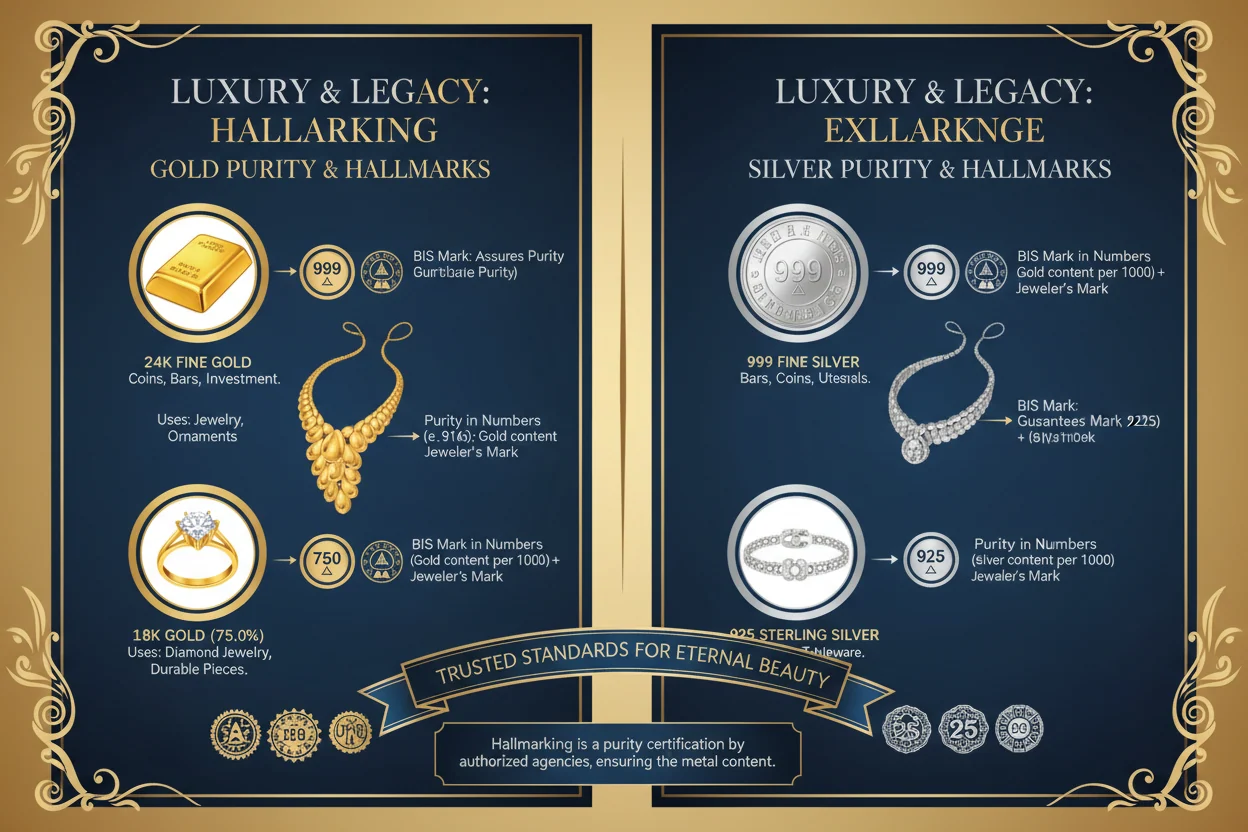
| 24K | 99.9% | 999 |
| 22K | 91.6% | 916 |
| 21K | 87.5% | 875 |
| 18K | 75.0% | 750 |
| 14K | 58.5% | 585 |
The fineness system is standardised internationally for jewellery alloys (ISO 9202), which is why the same numbers appear on gold in very different countries. A “916” is a “916” whether it was struck in Lahore, London or Dubai.
A decoder for other marks you may see
| Mark | Meaning |
|---|---|
| GP | Gold plated — a thin layer of gold over another metal |
| GF | Gold filled — a thicker bonded layer, still not solid gold |
| RGP | Rolled gold plate — similar idea, not solid gold |
| 925 | Sterling silver (92.5% pure) |
| 999 (on silver) | Fine silver (99.9% pure) |
If a piece is stamped with any of the first three, it is not solid gold, whatever the price tag implies.
How Gold Is Tested Before It Is Marked
Testing is what gives a hallmark its meaning. Different methods exist, and they are not equally reliable.
| Method | How it works | Damages the piece? | Accuracy | Best for |
|---|---|---|---|---|
| Touchstone and acid | A tiny scratch is compared against reference samples using acids | Slightly (a scratch) | Moderate; depends on skill | Quick traditional checks |
| Electronic tester | Measures electrical properties of the surface | No | Moderate; can mislead on plated or hollow items | Fast shop-floor screening |
| XRF analysis | An X-ray beam reads the metal’s composition | No | High — but reads only a very thin surface layer | Non-destructive testing of finished jewellery |
| Fire assay (cupellation) | A small sample is melted and measured | Yes (small sample) | The most accurate; the reference method | Bullion and definitive disputes |
Why this matters to you: a heavily gold-plated item can fool a surface-reading test. This is why serious hallmarking and bullion verification rely on methods that look beyond the surface, and why you should be wary of a “test” done in seconds on a high-value piece.
The usual hallmarking process
- Submission — the maker or retailer sends the item for testing.
- Sampling or scanning — a sample is taken or the piece is analysed non-destructively.
- Assay — the metal content is measured.
- Comparison — the result is checked against the claimed fineness.
- Marking — if it passes, the hallmark is applied; if not, the item is rejected or must be corrected.
- Record — in many schemes, the result is logged against the maker and the piece.
Why Hallmarking Matters: Six Real-World Reasons
1. It protects you from paying for gold you do not get
Purity is invisible. Without verification, the only thing between you and a mislabelled piece is the seller’s honesty. A hallmark turns that into something checkable.
2. It makes prices comparable
When two jewellers both sell “22K,” a verified 916 mark means you are comparing like with like. Without it, a lower price may simply be lower purity.
3. It protects resale value
When you sell or exchange, the buyer tests the piece. A verified mark makes that conversation faster and reduces disputes about purity.
4. It supports insurance and valuation
Insurers and valuers generally want documented purity and weight. A hallmarked piece with a receipt is far easier to document than an unmarked one.
5. It supports accurate Zakat calculation
Zakat is calculated on the value of the pure gold you hold. Knowing the true purity of each piece lets you calculate on what you actually own. Our Gold Zakat Calculator uses the live rate and a built-in Nisab check once you know the karat.
6. It builds trust in the market as a whole
Where marking is credible, honest sellers are rewarded and careless ones are exposed. Everyone benefits when “22K” reliably means 22K.
What a Purity Shortfall Actually Costs: A Worked Example
Let’s make this concrete. The figures below are illustrative only — chosen to show the method, not today’s market price. For real numbers, use the live homepage calculator.
Assume 24K = Rs 100,000 per tola, and you buy a 5-tola necklace sold as 22K that turns out to be 21K.
| Sold as 22K | Actually 21K | |
|---|---|---|
| Price per tola (from the purity ratio) | ≈ Rs 91,750 | ≈ Rs 87,590 |
| Value of the metal in 5 tola | ≈ Rs 458,750 | ≈ Rs 437,950 |
| Metal you overpaid for | ≈ Rs 20,800 (about 4.5%) |
And this is before making charges. If a percentage making charge was calculated on the higher figure, the real loss is larger still. The shortfall is quiet, plausible and entirely invisible to the eye, which is exactly why the verification matters more as pieces get heavier.
How Other Countries Do It
Understanding other systems shows what a strong scheme looks like — and what to ask for at home.
| Country | System | Notable features |
|---|---|---|
| United Kingdom | Compulsory hallmarking of precious-metal items above small weight limits, through independent assay offices | One of the oldest systems in the world — English hallmarking dates back to 1300; marks include a sponsor’s mark, a fineness mark and an assay office mark |
| India | Hallmarking made mandatory in phases from 2021 under the national standards body (BIS) | Each article carries a unique six-character ID (HUID) from 2023, so a piece can be traced to its tester |
| Much of Europe | National systems and a shared “common control mark” among participating countries | Cross-border recognition of tested items |
The pattern in strong systems is the same: independent testing, a mark that can be traced, and legal consequences for false marking. Those are the three things worth looking for in any piece, anywhere.
Hallmarking in Pakistan: What to Expect and What to Ask
Here, honesty matters more than reassurance. In Pakistan, practice varies by shop and by city. Many jewellers strike their own karat stamp and shop mark, and trust has traditionally rested on a jeweller’s reputation and long relationships. Some jewellers and laboratories offer independent testing and formal marking; others do not. Rules and enforcement can also change over time, so confirm the current position with the relevant standards authority or the jeweller’s own documentation.
That means your own verification habits are your main protection. Our purity verification guide walks through the basics; the questions below put them into practice.
Five questions worth asking any jeweller
- “Is this piece hallmarked by an independent testing body, or is the stamp yours?”
- “What is the exact karat and fineness of this piece?” — and have it written down.
- “Can you weigh it in front of me on a calibrated scale?”
- “Will you put the karat, gross weight, today’s metal rate and making charge on the receipt as separate lines?”
- “If I get it tested independently and it is below the stated purity, what will you do?”
A confident, established seller will answer all five without discomfort. Hesitation is information.
How to Check a Piece in Your Hand
You do not need equipment to spot some problems. Start here:
- Find the stamp — usually on the clasp, the inside of a ring or an inconspicuous edge.
- Look closely with a 10x jeweller’s loupe or a phone camera zoom. Genuine marks are usually crisp and evenly struck; blurry, uneven or oddly deep marks deserve questions.
- Match it to the claim. If the seller says 22K, you should see 22K or 916, not something else.
- Check for plating tell-tales — worn edges showing a different colour, or a stamp such as GP, GF or RGP.
- Weigh it and compare against the weight on the receipt.
- For a large purchase, get it tested independently before or immediately after buying, at an established jeweller or testing laboratory.
A warning about DIY tests. Home acid kits can damage a piece and give false readings if used wrongly. A magnet does not test gold purity — gold is non-magnetic, and so are many fakes. Leave testing to professionals and rely on a combination of stamp, weight, documentation and independent testing.
Red flags
- No stamp at all on a high-value piece, with no clear explanation
- A stamp that does not match what the seller says
- A price far below today’s live rate for that karat
- Refusal to weigh the piece or allow testing
- Pressure to buy quickly or to skip the receipt details
What a Hallmark Does — and Does Not — Tell You
A hallmark is powerful, but it is not magic. Knowing the limits protects you from false confidence.
| ✅ A hallmark helps confirm | ❌ A hallmark does not tell you |
|---|---|
| The metal type | The weight of the piece |
| The fineness grade (for example 916) | Whether the price is fair |
| That an independent party tested it (for an assay hallmark) | The making charge being fair |
| Traceability to a tester or maker, where the scheme provides it | The quality of gemstones set in the piece |
The practical conclusion: use the hallmark to settle purity, then separately check weight, making charge and price against the live rate. Each question needs its own answer.
Hallmarks on the Three Common Karats — and on Silver
24K: bars and coins
Investment gold usually carries a 999 stamp, a weight stamp and a refiner or mint mark, sometimes with a serial number on larger bars. For investment purchases the paperwork matters as much as the metal; see our 24K gold guide for certification and storage detail.
22K: bridal and heirloom jewellery
The 916 stamp is the one to look for. Because bridal sets are heavy and expensive, this is the karat where verification pays off most — see the 22K gold guide.
21K: everyday jewellery
Look for 875 or 21K. It is the everyday workhorse, so check it just as carefully despite the lower price per piece; our 21K gold guide explains why this karat dominates retail.
If you are still deciding between them, our 24K vs 22K vs 21K comparison shows which suits which purpose.
Silver
Silver follows the same logic: 925 means sterling (92.5% pure) and 999 means fine silver. Purity checks matter there too — see our silver rate and purity guide.
Myths, Corrected
❌ “If it has a stamp, it has been hallmarked.”
✅ A stamp may be the jeweller’s own claim. A hallmark implies independent testing.
❌ “A hallmark guarantees a good price.”
✅ It confirms purity only. Weight and making charges still need checking.
❌ “A hallmark means I don’t need a receipt.”
✅ The receipt records weight, rate and charges. You need both.
❌ “Old family jewellery without a mark must be fake.”
✅ Older pieces often predate modern marking. Get them tested rather than assuming either way.
❌ “I can test gold at home with a magnet or a kit.”
✅ Neither is reliable for purity, and kits can damage the piece. Use a professional test.
A Buyer’s Checklist
Copy this into your phone before your next purchase:
- Decide the purpose first — daily wear, occasional wear or savings.
- Check the live rate for that karat immediately before you go.
- Ask whether the stamp is independent or the shop’s own.
- Find and read the fineness mark on the piece.
- Watch the piece being weighed on a calibrated scale.
- Get karat, gross weight, rate and making charge itemised separately on the receipt.
- For large purchases, arrange independent testing.
- Keep the receipt and any certificate together, in more than one place.
Frequently Asked Questions
What is hallmarking in simple words?
Hallmarking is an official mark on precious metal that shows its type and purity after independent testing. It turns a seller’s claim into a verified fact.
Is the “22K” stamp on my jewellery a hallmark?
Not necessarily. It may simply be the jeweller’s own stamp. A true hallmark implies the piece was tested by an independent body. Ask which it is.
What does 916 mean on gold?
916 means 91.6% pure gold, which is 22 karat. It is the fineness stamp for 22K, just as 875 is for 21K and 999 is for 24K.
Can a hallmark be faked?
Marks can be copied, which is why a stamp alone is not proof. Combine it with weighing, a proper receipt and, for large purchases, independent testing.
Does hallmarked gold cost more?
Testing adds a small cost, but verified purity can save far more than that by preventing overpayment. Compare the total and the making charge separately.
Does a hallmark affect resale value?
It does not raise the metal’s value, but it speeds up verification and reduces disputes when you sell or exchange. Resale is still based on weight and purity.
How do I get old or unmarked jewellery tested?
Take it to an established jeweller or testing laboratory that can test without damaging the piece, and ask for the result in writing.
Do I need a hallmark for Zakat purposes?
No, but knowing true purity lets you calculate Zakat on the pure gold you actually own. The Zakat calculator linked earlier handles the Nisab check and live valuation.
How We Wrote and Checked This Guide
Because this topic involves your money, here is how this article was put together:
- Fineness figures (999, 916, 875, 750, 585) follow the standard karat and millesimal systems used internationally for jewellery alloys.
- Testing methods are described according to their general strengths and limits; no single method is perfect, and we say so.
- International examples are summarised at a high level; regulations change, so always check current rules at the source.
- Pakistan section: practice and enforcement vary and can change. We describe general practice and practical buyer steps, not legal requirements.
- The worked example is clearly labelled illustrative and is not a quoted price.
- Live rates are verified against the Sarafa benchmark and international spot pricing, as explained on our About Us page.
- Corrections: if you spot something wrong or out of date, please contact us — every report is reviewed.
Not legal, financial or religious advice. This is general educational information about gold hallmarking. Confirm current rates, making charges and any applicable rules directly with your dealer or the relevant authority, and consult a qualified scholar for personal Zakat rulings. See our full Disclaimer.
🔗 Explore the City Guides
Local markets, trusted jewellers and making-charge ranges differ from city to city. Read the guide for yours: Karachi · Lahore · Islamabad · Rawalpindi · Faisalabad
Written by Muhammad Usman, Founder & Editor of GoldRateInPakistan.org.pk. Last reviewed October 2026. Rules, rates and ranges change — always verify before a transaction.
2 thoughts on “What Is Hallmarking and Why It Matters”