Purity, price maths, durability, hallmarks and making charges — and exactly which karat to buy for jewellery, investment or Zakat.
✍️ Written by Muhammad Usman, Founder & Editor · 🔍 Last reviewed: October 2026 · ⏱ 13-minute read
💡 The Short Answer
- 24K (99.9% pure) → best for investment: bars and coins, almost no making charges.
- 22K (91.6% pure) → best for bridal and heirloom jewellery: richest colour, still workable for detailed designs.
- 21K (87.5% pure) → best for everyday wear: toughest of the three and usually the lowest total cost.
- Here is the part most guides miss: per gram of actual pure gold, all three cost exactly the same. The price gap between karats is just the extra gold you receive. The real cost difference comes from making charges and design — not the metal.
📑 What’s Inside
- The 60-second comparison table
- How the karat system actually works
- 24K gold in detail
- 22K gold in detail
- 21K gold in detail
- Head-to-head: five tests that matter
- Worked example: the same budget, two karats
- How to verify the karat you are buying
- Which karat should you buy? A decision guide
- Zakat and the three karats
- Five myths, corrected
- Frequently asked questions
- How we wrote and checked this guide
The 60-Second Comparison Table
| 24K | 22K | 21K | |
|---|---|---|---|
| Purity | 99.9% | 91.6% | 87.5% |
| Hallmark stamp | 999 | 916 | 875 |
| Alloy metals | ~0.1% | ~8.4% | ~12.5% |
| Pure gold in one tola (11.664 g) | ≈ 11.65 g | ≈ 10.68 g | ≈ 10.21 g |
| Colour | Deepest, richest yellow | Rich, warm yellow | Slightly paler yellow |
| Hardness / durability | Very soft | Moderate | Best of the three |
| Typical use | Bars, coins, savings | Bridal and fine jewellery | Daily-wear jewellery |
| Price per tola | Highest | Middle | Lowest of the three |
| Typical making charges | Minimal (bars, coins) | Roughly 10%–25% | Roughly 7%–20% |
One rule explains the whole table: the purer the gold, the softer it is. Every buying decision below follows from that single trade-off between value per gram and survival under daily wear.
Live prices for each karat are tracked on that karat’s own page and refreshed automatically — you will find each link in the matching section below. This article is about choosing between them, so you know what you actually want before you look at a price.
How the Karat System Actually Works
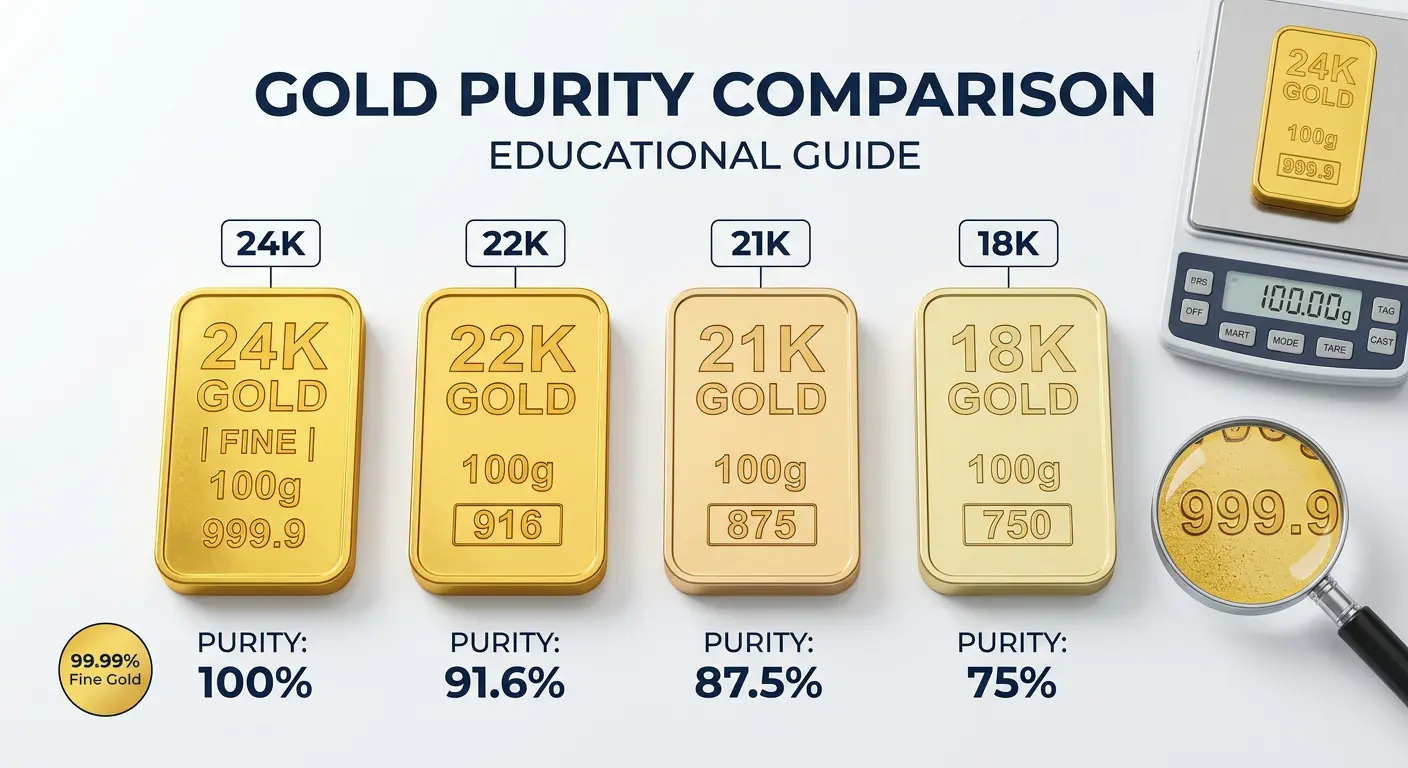
The karat number answers one question: how many parts out of 24 are pure gold?
- 24K = 24 of 24 parts gold
- 22K = 22 of 24 parts gold (22 ÷ 24 ≈ 91.7%, stamped 916)
- 21K = 21 of 24 parts gold (21 ÷ 24 = 87.5%, stamped 875)
The remaining parts are alloy metals — usually copper, silver or zinc. They are not filler added to cheat you; they are what make jewellery physically possible. Pure gold is so soft that a 24K ring can bend or scratch in normal use, so alloy is added for strength.
Why is 24K “99.9%” and not 100%?
Refining gold to a mathematically perfect 100% is not practical. The international standard for “fine” gold is 999 parts per thousand, which leaves a trace of other elements. This tiny margin has no meaningful effect on value, and it is why 24K bars are stamped 999 (or 999.9 for some refiners).
The three-digit stamps
Alongside karat numbers you will see the millesimal fineness system — purity out of 1,000 instead of 24. It is the system behind the international jewellery fineness standard (ISO 9202), and it is more precise than the karat label alone:
| Karat | Millesimal stamp |
|---|---|
| 24K | 999 |
| 22K | 916 |
| 21K | 875 |
| 18K | 750 |
Both systems describe exactly the same thing. If a piece says “22K” and “916,” those are two ways of writing one fact.
24 Karat Gold: The Investment Standard
What it is: the purest commercially traded gold, at 99.9%.
What it is used for: gold bars, gold coins, and some thick ceremonial pieces that are never worn hard. It is deliberately avoided for rings, bangles and detailed jewellery, because fine detail made from such a soft metal loses its shape.
Why people buy it:
- ✅ Lowest premium over the raw metal price — you are paying almost entirely for gold, not labour.
- ✅ Resale tracks the market price closely, because there is little design cost to lose.
- ✅ Simple to value — no purity adjustment needed, which is why some households keep part of their savings in 24K to make yearly Zakat calculation easier.
Where to be careful:
- ⚠️ Scratches and dents easily, so it needs careful storage.
- ⚠️ Physical bars need secure storage and insurance thought, not a dresser drawer.
- ⚠️ A certificate and a reputable seller matter more here than anywhere, because the sums are larger.
For bars versus coins, certification marks, storage and PMEX alternatives, read the dedicated 24K investment guide.
22 Karat Gold: The Bridal and Heirloom Standard
What it is: 91.6% pure gold with about 8.4% alloy — usually copper, silver, or a mix of both.
Why it dominates bridal jewellery: detailed techniques like kundan stone-setting, fine filigree and engraving need gold that is soft enough to shape precisely but strong enough to hold that shape afterwards. 22K sits in that window, while keeping the deep, warm colour South Asian families associate with fine jewellery. That is a big part of why Lahore’s Walled City artisans are known for elaborate 22K bridal work.
Where it shines:
- ✅ The richest colour of any jewellery-grade karat — it photographs beautifully under wedding lighting.
- ✅ Strong cultural association with heirloom pieces meant to be passed down and re-worked for later generations.
- ✅ Widely recognised and easy to resell across South Asia and the Gulf.
Where it struggles:
- ⚠️ Softer than 21K, so daily wear on rings and bangles shows up over the years.
- ⚠️ Intricate designs usually carry higher making charges.
The full story of the 916 hallmark, care tips and cultural history is on the 22K gold guide.
21 Karat Gold: The Everyday Standard
What it is: 87.5% pure gold with 12.5% alloy.
Why Pakistani jewellers stock it by default: as retail moved from bespoke orders to ready-made stock, shops needed a karat that survives genuine daily wear but still looks convincingly rich. 21K does both. Many buyers cannot reliably tell 21K from 22K by eye, yet 21K resists scratching and bending noticeably better.
Where it shines:
- ✅ Best durability of the three — ideal for wedding bands, chains, bangles and anything worn constantly.
- ✅ Lower price per tola and typically lower making charges, because everyday designs are simpler to produce.
- ✅ Easy to find: nearly every retail jeweller in the country stocks it.
Where it struggles:
- ⚠️ Slightly paler than 22K when placed side by side.
- ⚠️ Less recognised as the “default” karat outside Pakistan and parts of the Gulf — worth telling a recipient if you are gifting abroad.
See why Pakistan leans on 21K while India stays closer to 22K, plus common designs and care, in the 21K gold guide.
Head-to-Head: Five Tests That Matter
1️⃣ Purity and Real Value
Here is the insight that changes how you compare prices. Because every karat is priced from the same 24K benchmark, 22K costs about 91.7% of the 24K price and 21K about 87.6% (the extra fraction exists because 24K itself is 99.9%, not 100%). That gap is not a discount or a mark-up — it is simply the gold you are not getting.
Check it yourself: price per tola ÷ purity gives the cost of one tola’s worth of pure gold. For 24K, 22K and 21K on the same day, the answer comes out identical.
So buying a lower karat does not make the metal cheaper per unit of gold. It makes each piece cost less in total because it contains less gold. This is exactly how our own live tables work: when 24K moves, 22K and 21K move in the same proportion. Every karat’s live number on our site is derived from one verified benchmark.
2️⃣ Durability
| Situation | Best choice | Why |
|---|---|---|
| Wedding ring worn daily | 21K | Hardest of the three |
| Bridal set worn a few times a year | 22K | Richer colour; wear is minimal |
| Bar or coin kept in storage | 24K | No wear; lowest premium |
| Manual work, gym, frequent hand-washing | 21K (or lower) | Resists deformation |
| Piece to be re-worked for future weddings | 22K | Traditional, workable, widely valued |
3️⃣ Colour
The differences are real but subtle. 24K is an unmistakably deep, almost orange-tinted yellow. 22K is rich and warm, slightly lighter. 21K is close enough to 22K that most people need a hallmark — not their eyes — to tell them apart. Never rely on colour to identify a karat.
4️⃣ Making Charges
Making charges are the labour cost of shaping the gold, and they are separate from the metal rate. They differ between karats mainly because of what gets made:
| Karat | Typical making charges* | Why |
|---|---|---|
| 24K | Minimal to none | Bars and coins involve almost no design labour |
| 22K | ~10%–25%+ | Intricate bridal craftsmanship, hand finishing |
| 21K | ~7%–20% | Simpler, higher-volume everyday designs |
<sub>*Typical ranges quoted by Pakistani jewellers. Actual charges vary by city, shop and design — always get the figure quoted separately. Local ranges are covered in the city guides listed at the end of this article.</sub>
5️⃣ Resale
When you sell, a dealer typically pays for metal weight and purity — and generally does not return the making charges you paid. That makes resale value tilt toward 24K bars (little to lose) and away from heavily crafted pieces in any karat. It is the single biggest reason people who want pure savings avoid jewellery altogether.
Worked Example: The Same Budget, Two Karats
Let’s make the maths concrete. These numbers are illustrative only — chosen to show the method, not today’s market price. For real figures, use the live homepage calculator.
Assume 24K = Rs 100,000 per tola, and you want a 2-tola bangle set.
| 22K bridal design | 21K everyday design | |
|---|---|---|
| Price per tola (from the ratio) | ≈ Rs 91,750 | ≈ Rs 87,590 |
| Metal cost for 2 tola | ≈ Rs 183,500 | ≈ Rs 175,180 |
| Making charge (assumed) | 18% ≈ Rs 33,030 | 10% ≈ Rs 17,518 |
| Estimated total | ≈ Rs 216,530 | ≈ Rs 192,698 |
What this shows: the total differs by roughly 12% — but only about 5% of that comes from the metal. The rest is making charges. Two shops quoting the same karat can differ more than two karats do, which is why comparing total prices without splitting out the making charge is the most common mistake buyers make.
How to Verify the Karat You Are Buying
Sellers can be perfectly honest and still be wrong, so verify anything meaningful. Work through this checklist:
- Find the stamp — usually on the clasp or an inconspicuous edge: 999, 916 or 875 (or the karat label itself).
- Ask what the stamp means — the answer should match the table above, not a vague “it’s good gold.”
- Watch the weighing — a calibrated scale, in front of you, before any price is discussed.
- Get it written — gross weight, karat, the day’s metal rate and the making charge, each on its own line of the receipt.
- Test larger purchases — acid testing, an electronic tester, or XRF (the most precise, non-damaging method) at an established jeweller or assay office.
- Check the maths — multiply weight by today’s live rate for that karat and compare it to the metal portion of the quote.
Red flag: a price far below the day’s live rate for the stated karat. The gap has to come from somewhere — usually a lower real purity or a lower real weight.
Local notes on where to find reliable testing are in the city guides listed at the end of this article.
Which Karat Should You Buy? A Decision Guide
| If your goal is… | Choose | Reason in one line |
|---|---|---|
| Pure savings or investment | 24K bars or coins | Smallest premium; resale tracks the metal |
| Bridal set or heirloom | 22K | Richest colour; workable for detailed designs |
| Wedding ring or daily chain | 21K | Toughest and usually cheapest in total |
| Gifting a small, symbolic piece | 24K coin | Simple, recognisable, easy to value |
| Lowest total spend on a wearable piece | 21K (or lower) | Less gold, simpler design, lower making charge |
| Gold you may sell abroad | 22K or 24K | Most widely recognised internationally |
| Not ready for any gold yet | Consider silver | See the silver rate guide |
There is no universal “best” karat — only the right one for the job. Decide the purpose first (worn daily, worn rarely, or never worn), and the karat follows.
Zakat and the Three Karats
Zakat on gold is calculated on pure gold value, using today’s market price — not the price you paid. Under the widely followed approach:
- Nisab: 7.5 tola (87.48 grams) of gold
- Condition: held for one full lunar year (Hawl)
- Rate: 2.5% of the current market value
All three karats are Zakatable, and the majority scholarly position includes jewellery worn regularly. Because 22K and 21K contain less than a full tola of pure gold per tola of weight, the value you calculate on should reflect the karat you hold. Our Gold Zakat Calculator does this automatically, including the Nisab check, using the live rate.
Rulings can differ between schools of thought, and this is general information rather than a fatwa. For your personal situation, ask a qualified scholar.
Five Myths, Corrected
❌ “24K is always the best gold to buy.”
✅ It is best for investment. For anything worn daily, its softness is a real disadvantage.
❌ “Lower karat means worse quality.”
✅ A lower karat is a different tool, engineered for durability. A 21K ring is not an inferior 24K ring — it is a ring that survives.
❌ “I can judge the karat by colour.”
✅ Colour differences between 22K and 21K are subtle and alloy-dependent. Use the hallmark and testing.
❌ “The metal price is where shops cheat.”
✅ The metal price follows the public benchmark. Differences between shops mostly live in the making charge — so compare that, not just the total.
❌ “22K is always more expensive overall than 21K.”
✅ Per tola, yes. But a lighter 22K piece can cost less than a heavier 21K one. Weight and making charge decide the final bill.
Frequently Asked Questions
Is 24K, 22K or 21K the best gold?
None is best in general. 24K suits investment, 22K suits bridal and heirloom jewellery, and 21K suits everyday wear. The right choice depends on what you will do with the piece.
Why is 21K so common in Pakistan?
Retail jewellers standardised around 21K because it balances rich colour with real durability for daily wear, at a lower price per tola than 22K. Many buyers cannot tell it from 22K by eye.
Can 22K and 21K gold be melted together?
A jeweller can melt different karats together, but the resulting purity is a blend — it does not become a clean 21K or 22K by adding weights. The piece must be re-tested and relabelled.
Does a higher karat always cost more overall?
Per tola, yes, because it holds more pure gold. But the total bill also depends on weight and making charges, so a lighter high-karat piece can cost less than a heavier low-karat one.
What do 999, 916 and 875 mean?
They are purity stamps out of 1,000: 999 means 24K, 916 means 22K and 875 means 21K. They are a more precise way of writing the same purity as the karat number.
Is gold jewellery that I wear daily subject to Zakat?
The majority scholarly position says yes, once your total qualifying gold reaches Nisab and has been held for a lunar year. Views can differ, so consult a scholar for your case.
How do I make sure I am not overcharged?
Get gross weight, karat, the day’s metal rate and the making charge itemised separately, then check the metal portion against the live rate for that karat.
Where can I see today’s rate for each karat?
Live, automatically refreshed figures are on our homepage and on the individual 24K, 22K and 21K pages linked in the sections above.
How We Wrote and Checked This Guide
Because this topic involves your money, here is exactly how this article was put together:
- Purity figures (999 / 916 / 875 and the karat fractions) follow the standard karat and millesimal systems used internationally for gold fineness.
- Unit conversions use the standard tola (11.664 grams) and troy ounce (31.1035 grams), the same constants behind the live rate tables on this site.
- Price relationships are derived from the same purity ratios our rate engine uses; the worked example is clearly labelled illustrative and is not a quoted price.
- Making-charge ranges are typical ranges reported by Pakistani jewellers and are presented as a guide, not a guarantee — they change by city, shop and design.
- Live rates are verified against the Sarafa benchmark and international spot pricing, as explained on our About Us page.
- Corrections: if you spot something wrong or out of date, please contact us — every report is reviewed, and genuine errors are corrected.
Not financial or religious advice. This is general educational information about gold purity grades. Always confirm the current rate and making charges with your dealer before buying, and consult a qualified scholar for personal Zakat rulings. See our full Disclaimer.
🔗 Explore the City Guides
Making charges, trusted markets and local buying tips differ from city to city. Read the guide for yours: Karachi · Lahore · Islamabad · Rawalpindi · Faisalabad
Written by Muhammad Usman, Founder & Editor of GoldRateInPakistan.org.pk. Last reviewed October 2026. Rates and ranges change — always verify with your dealer before a transaction.
2 thoughts on “24K vs 22K vs 21K Gold: Full Comparison”